
What does an Engineering Manager do?

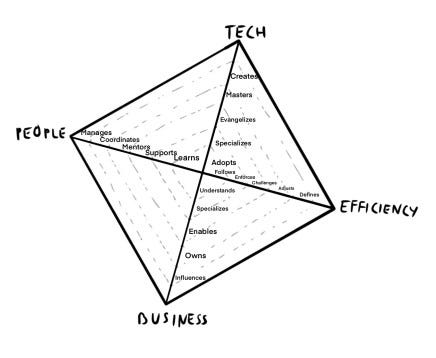
In this post I would like to talk about the role of Engineering Manager, the person responsible for the efficiency of delivery, the people and their development in the company.
Having discussed it with several people, this role can be quite different depending on the company. So I wanted to share our experience at Malt of this role.
We will try to read this function from 4 axes of analysis: human management, management of collective efficiency, business sense and technical expertise and we will see how we introduced this position in the team.
4 axis: expertise, human, collective, business
To start, I will start from a basic postulate. In a team, you have 4 major axes to work on.
On each of these axes, there may be one or more people in the team who work on it for the benefit of the group.
In order not to reinvent the wheel, I will start from the engineeringladders.com site and its representation on 5 axes.
I modified to keep only 4 axes of reading. On each I will indicate the equivalence.
- Technology
We are talking here about knowledge of frameworks, tools, and languages, architecture patterns and the level of influence on the system. It is the equivalent of Technology and system .
- optimization of collective efficiency
Here we are talking about very varied subjects but we can sum it up to "how we do things in the most efficient way possible". It's the equivalent of Process but I'm not a fan of that name. You have to be careful not to work for the process but for efficiency and success.
- human management
Human management includes, among other things, individual follow-up, coaching, recruitment, team building, training. It is the equivalent of People .
- business sense
How people works in the general interest of the company and understands its strategy in order to align the work of the team on it. No equivalent on engineeringladders.com radar . I consider it is a lack.
On this axis, since it is new on this post, I propose the following 5 levels:
- Understands : Understands business fundamentals and aligns with overall goals
- Specializes : has a good understanding of a business area of the company and serves as a referent
- Enablers : is able to offer solutions to solve problems in his or her business area
- Owns : is the functional manager for a business part of the product and co-define its future development
- Influences : is able to influence the company on its business area, visible at the level of its industry
On the other axes, I invite you to read the definition on engineeringladders.com .
Here is what it gives:
Let's see what it gives us at Malt.
The Engineering Manager at Malt
To settle a first definition in the context of Malt. The engineering manager for us is a managementrole, as opposed to the roles of leadership and individual contributors.
In an old post I took the time to talk about the "leadership" branch.
Let's go back to this diagram that I used:
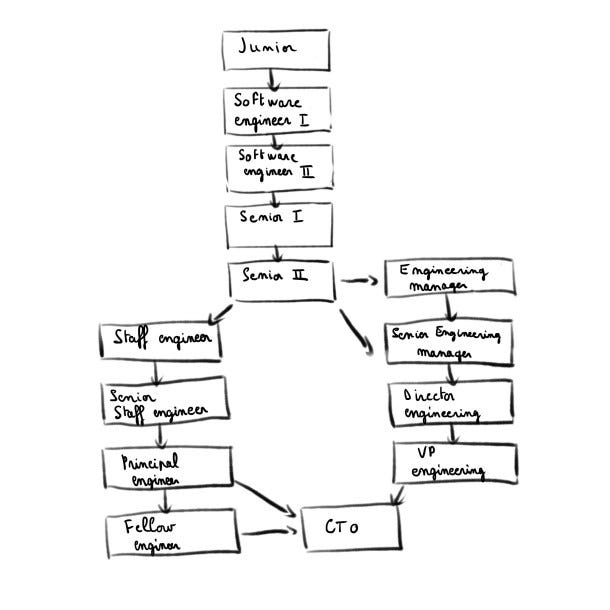
There are 3 distinct branches:
- the "individual contributor" branch which forms the common core and then evolves on the other two branches
- the leadership branch on the left. It is an extension of the "individual contributor" branch but with more expected impact and coordination
- the "management" branch, on the right, where we can find the famous Engineering Manager.
By schematizing, from the axes of reading defined above, this would give us (for a senior in this role):
As an individual contributor:
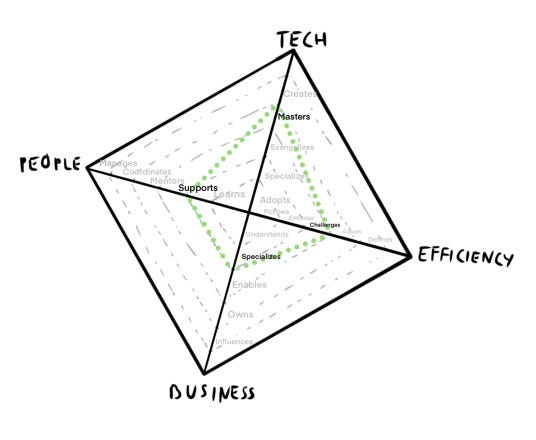
The senior individual contributor:
- is a referent on a business domain.
- masters all the technologies and the system on which it operates
- embodies and challenges best practices
- has a support role within his team
In Staff engineer and more (leadership branch)
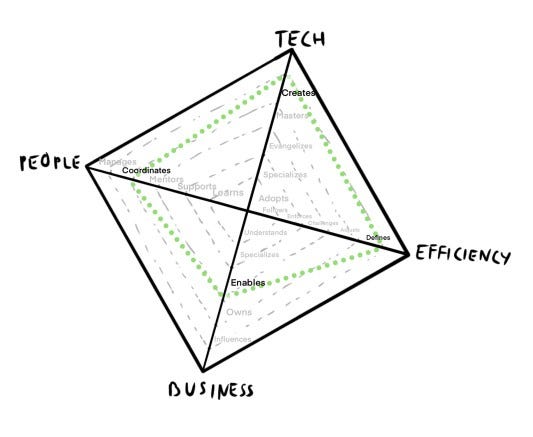
From this level, we are still on individual contributors, but we wait for the top notch:
- defines good practices at the engineering level (often in collaboration with the Engineering Manager)
- participates in the creation of the technological vision of the company and the way in which technology is valued
- his technological vision and his communication skills allow him to have an impact on the business
- he is able to coordinate several people on complex technological projects
An Engineering Manager :
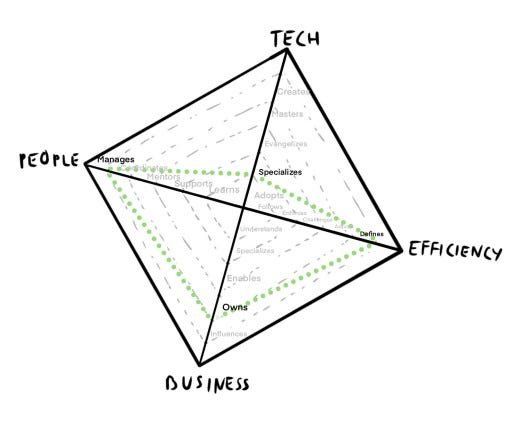
The Engineering Manager :
- manages individuals in the team to makes them improve
- has good technical basics (he/she can sometimes be an expert but it's not required) allowing him/her to be relevant on best practices and delivery
- defines the team's methods and processes in order to constantly accelerate the teams
- has a perfect knowledge of his/her business field in order to be able to help his team to stay aligned and make the right choices
In our case, his/her typical profile is a Senior, having been an individual contributor but today focused mainly on people and business.
I think you will have guessed for yourself that the person who "influences" the business, therefore at the maximum level on this axis, is the Product Manager.
But, you will tell me, is it the same thing as XXX?
XXX who can be Scrum Master, Tech Lead, Project Manager
Well, let's see that.
Engineering Manager versus Scrum Master
First of all, it must be understood that a Scrum Master is above all a role in the Scrum methodology, nothing more. It has become a job in its own right, for better and probably especially for worse...
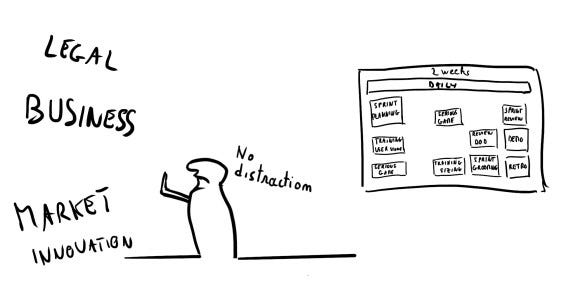
The primary missions of the Scrum Master are:
- Coach the team in the spirit of the method
- Shield in front of the team to protect them from disturbances
If we stop at the definition, the Scrum Master is what Marty Cagan calls a "process people". And I'll let you read what he says about it on his blog .
If we summarize this on the 4 axes seen previously:
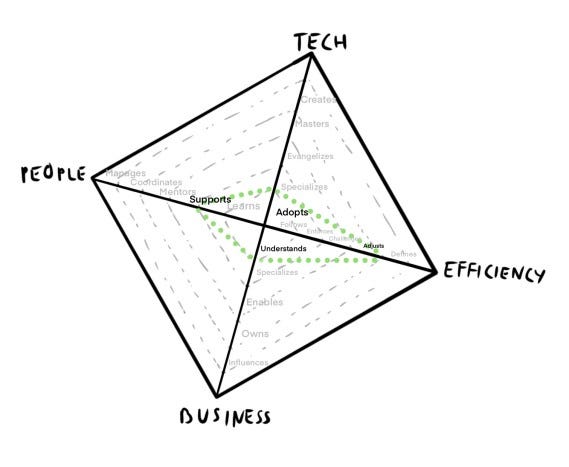
The subject is above all to ensure the collective efficiency of the team (while remaining within the framework of the Scrum methodology). The human aspect is present but the Scrum method does not define any responsibility for individual follow-up, training management, recruitment, etc.
As for business sense, by definition, being a "shield in front of the team" means putting the team first, before the company.
Does it tickle you?
The link with the business is in principle embodied by the Product Owner. But not by the Scrum Master.
I would like to quote Gergely Orosz in this post to emphasize the difference with the Engineering Manager:
As an engineering manager, you'll need to put the company first, team second, your team members third, yourself as fourth. Gergely of Russia
Well, I'm caricaturing a bit and there are many healthier structures where the Scrum Master is totally linked to the business and can take on other functions in the team. From my point of view, if there is no EM in the team, I prefer when this role is rotating in the team. But this assumes a good maturity of the team on Agile principles.
If an Engineering Manager is present, he/she is a good candidate to play this role of facilitator, while keeping in mind that he/she should not lock himself into this role because his/her responsibilities are broader and he/she must keep a distance .
Engineering Manager versus Project Manager
Let's take a look, the project manager is a rather vague term. It is often linked to a traditional mode of organization where we will speak of an IT project and not of a product.
The project manager is the person responsible for progress, planning and execution.
According to our axes seen before, this would be represented as follows:
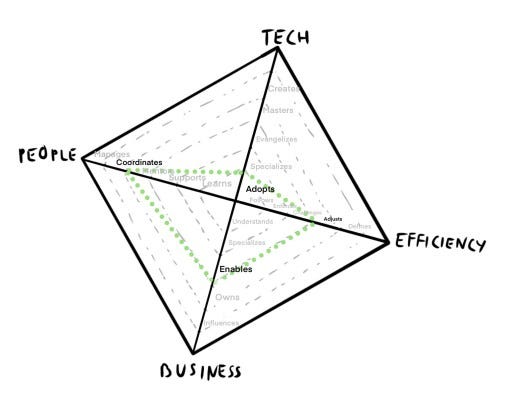
We will therefore note a particular focus on collective efficiency in order to keep schedules. I place the business axis on "medium" because in this type of organization we focus above all on the result (the output, the features), not the final impact, the outcomes. But I quibble.
It would be difficult to compare the two roles, these are positions that we find in different organizations and with a different culture. It wouldn't make sense to say that one is more this or that, it's the context that is radically different. I would say that the project manager is part of a more traditional project framework, while the Engineering Manager is part of a product culture.
Engineering Manager versus Tech lead
A necessary split?
I have seen many organizations in which the tech lead was also in charge of processes and people.
I have also seen organizations in which the engineering manager was in charge of a technical expert role in addition to the rest.
And why not ?
Isn't it possible that tech leads, in principle the most senior people, take on the two roles of expert and manager?
My conviction is that it is possible to find people with qualities on these 4 axes and who would be perfectly competent on each subject taken separately.
BUT , the main concern, apart from the scarcity of these individuals, is the time available .
Everyone has to make choices in their time management. If a "tech lead" decides to spend time to solve a technological challenge, it is less time spent on mentoring, recruitment, collective training, etc.
Conversely, if he decides to spend time each week with each member of the team, plus a few other key contacts on the team, he will be falling behind his development tasks. Even the management of his calendar will differ. The technical expert needs a range of uninterrupted working hours. The manager must be in multitasking regularly.
It's not a question of skills, you can be strong in both. But not at the same time.
Another shortcoming of having the roles of Engineering Manager and tech lead mixed is the risk of losing objectivity, or of being too day-to-day to continue developing long-term business acumen.
I also invite you to read this post from engineeringladders.com which deals with exactly this subject (also listed in the sources at the end of the post).
But it's all about scale.
At Malt, from 2014, the first dev recruited, to 2019, we had no person dedicated to the management of individuals and collective efficiency (except me as a CTO). This role therefore was the responsibility of the tech leads.
The introduction of the role at Malt
The role of Engineering Manager is quite recent for us. The first Engineering Manager was introduced in 2021.
The first time I heard about this role was in 2017. I met several EMs in different companies. And to be honest, I did not figure well what it could give to us.
In 2017 the engineering team was around 10 people, I was completely in charge of recruitment. The team was senior enough to be autonomous on organizational aspects and this seniority also limited people management needs. Of course, this situation had its limits. Especially for the less seniors who could not benefit from personalized follow-up and could feel limited in their possibilities of evolving without constant mentoring.
This is why we also had "leads" who took on this role of mentors and coaches. These leads could be represented as follows in their everyday roles:
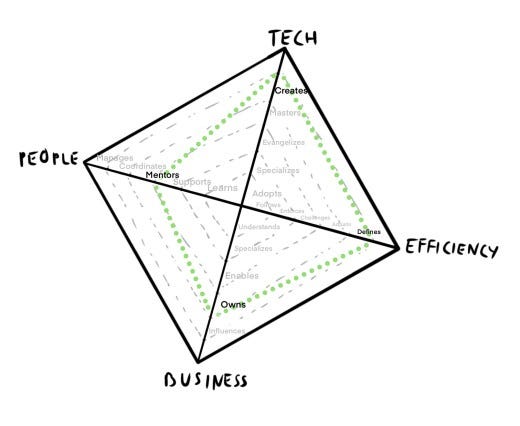
The situation was able to continue until 2019 but with several limitations:
- some discomfort from leads who did not want to go further in management, and experienced disruptions in their daily development
- less effective monitoring of juniors and intermediates
- increasingly time-consuming team efficiency topics due to team size
This is why at the end of 2019 we recruited a VP engineering in order to prepare the future stages of our growth.
( More info on the VP Engineering in an previous post )
Following this, the first position of Engineering Manager appeared at the end of 2020, as an extension of the action of the VP Engineering.
And to be complete, there was some reluctance at first.
Because, despite the fundamental concerns that had to be resolved, even more in a team where we had to double its size in 1 year, there is always the specter of the "project manager" which resurfaces fairly quickly. Yes, we can call it post traumatic syndrome
It's all about pedagogy on the one hand, but also being super vigilant about recruitment on a major point: corporate culture.
The engineering manager, incarnation of the corporate culture
Corporate culture is one of the portmanteau words, everyone talks about it, few know how to define it.
I once read a very basic definition, and at the same time very strong: culture is the sum of the practices used in the company . It was in the book "reinventing organizations" by Frédéric Laloux.
So, culture is the attitude you will adopt to respond to a situation. And when you formalize your culture, you ensure that this attitude is systematically the same, leaded by guiding principles.
There are lots of companies that use exactly the same tools as you, the same theoretical definitions of jobs, and yet culture can create a gigantic world between two seemingly identical companies.
Culture is, for example, how you will manage continuous training or the philosophy behind performance measurement .
But the Engineering Manager is a person who must embody this culture. He/She is one of the people who will be the binder in the team, and outside the team. She will work on collective efficiency, disentangle problems, facilitate communication and alignment with the strategy of the company, the department, the team.
In short, when recruiting, you have to be very vigilant about the match between the culture of the person and that desired in the company. It is necessary to bring freshness to practices, of course, but not to sacrifice one's culture.
Engineering manager career path
At Malt we have a progression path that is quite close to the standard:
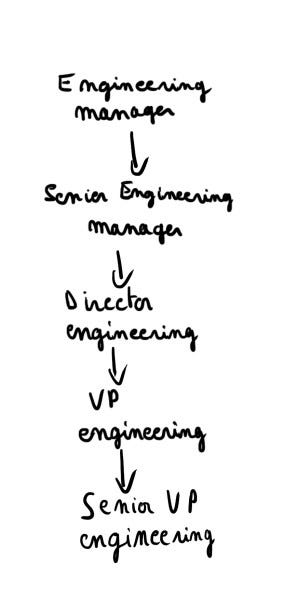
At each level there are two elements that will influence progress:
- the level of impact (or influence)
- the type of people to manage
By level of impact, I mean the ability to influence larger and larger circles: team (squads), community of practice, group of teams (tribe), department, company.
And by type of people to manage, I mean that it is quite different to manage individual contributors, than to manage managers.
Again, I'm going to refer you to the engineeringladders.com site which describes the progression by level rather well .
The Engineering Manager, cross-functional or within the teams?
At Malt we have chosen to associate an Engineering manager with two squads, which represents approximately 8/9 people in direct management.
But here's what you can find everywhere:
- one EM per squad (therefore 4/5 people in direct management)
- a transversal EM which has people to manage coming from different teams
The first option makes it possible to have more understanding of the work done in the team, or even to participate in it in certain cases (the number of people to manage being lower). The risk being to lack hindsight and thus to favor the team to the detriment of the collective, to maintain biases specific to a team, in particular in recruitment, or to have difficulty in making heavy decisions (because too close to the team) .
The second option allows management of individuals with a broader vision than the team (useful for example in the event of reorganization), to leave more time on subjects of collective efficiency (to the detriment of an active contribution within the team). a team) but can make it more difficult to understand the internal concerns of a team.
I feel like no solution is perfect. The choice will be quite contextual.
--- --- --- --- --- --- --- --- --- --- --- --- --- --- --- --- --- --- --- --- --- --- --- -
To conclude this post, I will try to make it more concrete by listing some topics covered by the Engineering Managers at Malt:
- Management of training and knowledge sharing
- The organization of Malt Tech days
- The structuring of the recruitment stages by profession
- Offsite organization
- Measuring the performance of the engineering team to set continuous improvement in motion
- The definition of individual progression paths by profession (career path)
- Arrival paths for new recruits
- The definition and implementation of metric monitoring by team
This list, far from being exhaustive, illustrates the diversity of subjects.
And if you want to go further, I invite you to browse the links indicated below in the sources.
SOURCE
http://www.engineeringladders.com/ : a great overview of the different roles in an engineering team. With 5 axes of analysis different from that of this post
http://www.engineeringladders.com/TechLead-EngineeringManager.html : another point of view on the difference between tech lead and Engineering Manager (similar to the one in this post)
https://blog.pragmaticengineer.com/things-ive-learned-transitioning-from-engineer-to-engineering-manager/ : the point of view of a dev having passed Engineering Manager
https://www.youtube.com/watch?v=Q_bJVokYLRI : a conference by Lena Reinhard on the profession of Engineering Manager


No comments yet. Be the first to comment!